How to Tune Fingerboard Trucks for Speed vs Stability
Fingerboard truck tuning is controlled primarily by two variables: kingpin nut tightness and bushing durometer. Tightening the kingpin nut compresses the bushings and reduces how far the hanger pivots, which increases stability but decreases turning response. Loosening allows more pivot angle and more fluid turning but reduces high-speed stability. Bushing durometer determines how much resistance the bushing offers at any given kingpin tightness — softer bushings (lower durometer) turn more easily under the same compression than firmer ones. The best truck tune is found by starting at a middle point and making small incremental adjustments while testing after each change.
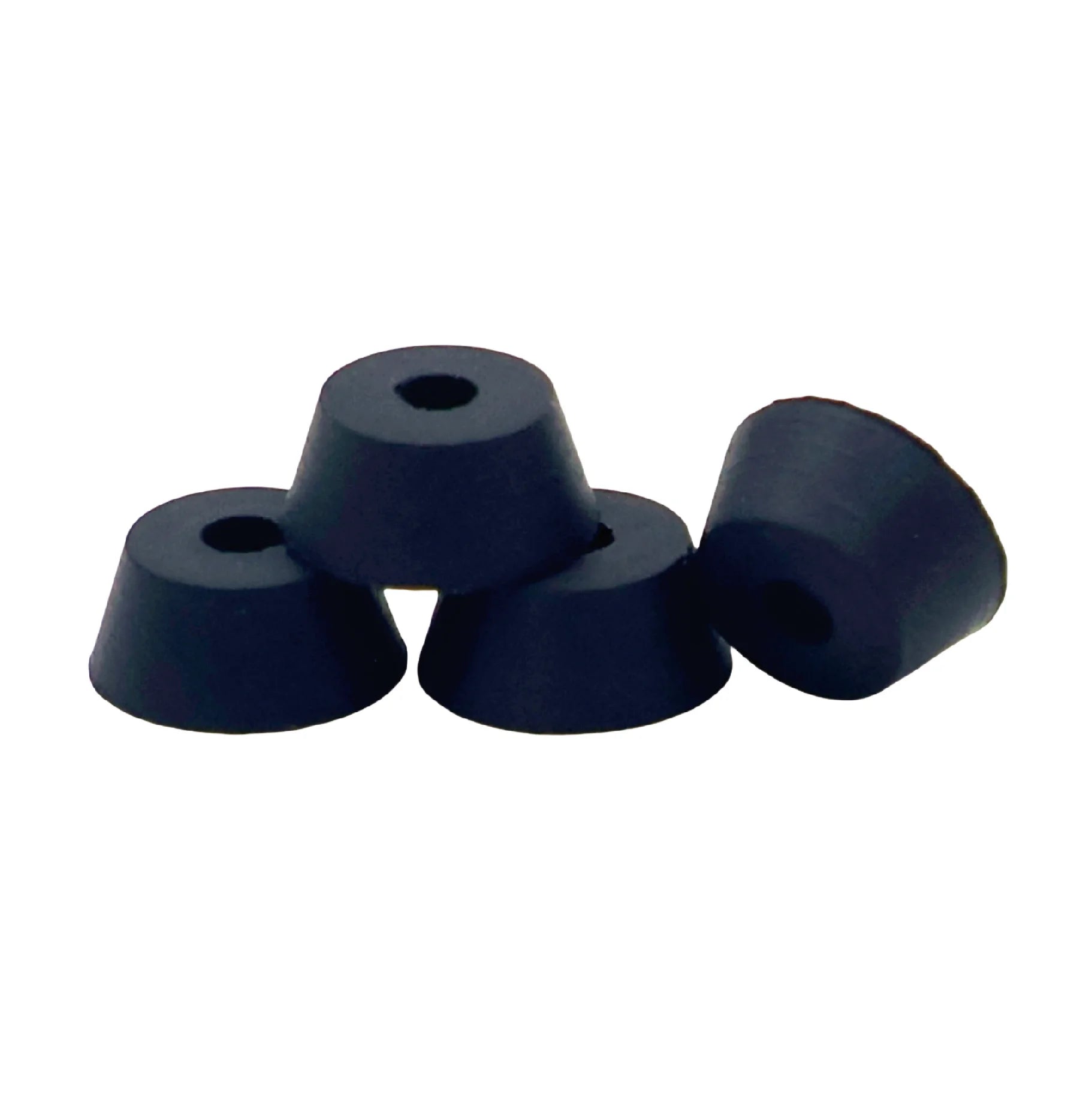
70A Cone Fingerboard Bushings
How Fingerboard Trucks Work
A fingerboard truck is a miniature version of a full-size skateboard truck with the same fundamental components: a baseplate that bolts to the deck, a pivot cup in the baseplate nose that the hanger pivot pin seats into, a hanger (the axle assembly), a bushing that sits between the hanger and the baseplate, a washer on each side of the bushing, and a kingpin bolt with a nut that compresses everything together.
When you press a side of the fingerboard deck to initiate a turn, the hanger pivots around two points simultaneously: the pivot pin in the pivot cup, and the compressed bushing. The bushing acts as a spring, allowing the hanger to pivot under force and returning it toward center when the force is released. Everything about how your trucks turn — responsiveness, return-to-center feel, stability — is determined by how easily the bushing compresses and how freely the pivot moves.
Kingpin Nut Tightness: The Primary Tuning Variable
The kingpin nut is the most direct and accessible tuning control on a fingerboard truck. Tightening the nut increases the pre-compression on the bushing, which means more force is required to initiate a turn and the hanger returns to center more forcefully. The result is a more stable truck that is less responsive to side pressure — better for high-speed lines, manuals, and grinds where you want the board to track straight.
Loosening the kingpin nut reduces pre-compression, allowing the bushing to compress more easily with less side force. The truck becomes more responsive and pivots more readily through turns, which is desirable for carving, flowing lines, and tricks where directional changes need to happen fluidly. The tradeoff is that at very loose settings the truck can feel unstable, particularly during manuals where even small imbalances cause the board to wobble.
As a practical starting point, thread the kingpin nut until it just contacts the washer with zero play, then add a quarter turn of tightening. Ride from that baseline and adjust in small increments from there. A quarter turn of the nut makes a noticeable difference in feel at fingerboard scale, so avoid making large adjustments and expecting to fine-tune afterward.
Bushing Durometer: The Secondary Tuning Variable
Bushing durometer is a measurement of the bushing's hardness, expressed on the Shore A scale. A lower Shore A number means a softer bushing that deforms under less pressure; a higher number means a firmer bushing that requires more force to compress. In fingerboarding, bushings typically range from around 85A (very soft and responsive) to 97A or higher (very firm and stable).
The relationship between kingpin tightness and bushing durometer is interactive, not independent. A very soft bushing tightened to a firm kingpin setting will feel different from a very firm bushing at the same tightness because the bushing's intrinsic resistance changes the baseline from which the kingpin compression adds to. This is why both variables should be considered together when tuning.
If you want a more responsive truck setup, the effective approach is to use a softer bushing and a moderate kingpin tightness rather than simply loosening the kingpin on a firm bushing. Soft bushings compress more progressively, which gives a smoother, more gradual turn-in feeling. Conversely, if you want maximum stability, a firm bushing combined with moderate-to-tight kingpin tension produces a more locked-in feel than simply overtightening a soft bushing.
The Role of Washers and Pivot Cups
Washers sit on each side of the bushing stack between the bushing faces and the baseplate on one side and the hanger on the other. Their primary job is to distribute the compression force of the kingpin nut evenly across the bushing face, preventing the bushing from deforming unevenly or wearing at a point rather than across its full surface. Cupped washers (concave in profile) cup around the bushing and constrain lateral deformation, producing a more controlled and responsive feel. Flat washers allow the bushing to deform more freely in all directions, which can feel looser and more pivoting.
The pivot cup is the small, typically polyurethane insert in the nose of the baseplate where the hanger's pivot pin seats. A worn or cracked pivot cup allows the pivot pin to rattle and move unpredictably inside the cup, which produces a loose, clunky feel in turns that no amount of kingpin adjustment can compensate for. If you notice an unpredictable looseness in turning that does not change when you adjust the kingpin, check the pivot cup for wear or cracking and replace it if necessary.
Test-and-Adjust: The Right Way to Dial In Trucks
The most reliable way to find your preferred truck tune is to establish a baseline and make incremental adjustments, riding briefly after each change. Set both trucks identically to start, using the quarter-turn-past-contact baseline described earlier. Then practice a specific trick or run that requires turning and stability to serve as your test benchmark.
If the trucks feel too stiff and unresponsive during turning and carving, loosen each nut by a quarter turn and retest. If they feel too loose and wobbly during manuals or straight-line tricks, tighten by a quarter turn and retest. Keep both trucks matched in tightness unless you have a specific reason to differentiate them, as mismatched tightness causes the board to pull toward one side during straight-line riding.
Once you reach a kingpin tightness you like, note it as your reference point so you can return to it after future disassembly or hardware changes. If you reach the limits of what kingpin adjustment can provide and still want meaningfully different performance, that is when a bushing durometer change is warranted.
Truck Tuning Quick Reference
| Setting | Turning Response | Stability | Best For |
|---|---|---|---|
| Loose kingpin + soft bushing | Very high | Low | Carving, flowing lines |
| Loose kingpin + firm bushing | High | Moderate | Responsive street tricks |
| Medium kingpin + soft bushing | Moderate | Moderate | All-around versatile tuning |
| Medium kingpin + firm bushing | Low-moderate | High | Manuals, grinds, fast lines |
| Tight kingpin + firm bushing | Low | Very high | Maximum stability, speed |
Frequently asked questions
How tight should fingerboard truck kingpin nuts be?+
Start by threading the kingpin nut until it just contacts the washer with no play, then add a quarter turn of tightening as a baseline. From there, adjust in small quarter-turn increments while testing after each change. Overly tight trucks restrict turning completely; overly loose trucks wobble during manuals and straight-line riding.
What does bushing durometer mean for fingerboard trucks?+
Durometer is a measurement of bushing hardness on the Shore A scale. Lower Shore A numbers (softer bushings) compress more easily and produce more turning response. Higher Shore A numbers (firmer bushings) require more force to compress and provide more stability. Most fingerboard bushings range from around 85A to 97A.
Should my front and back fingerboard trucks be the same tightness?+
In most cases yes. Matching tightness keeps the board tracking straight and makes tricks more predictable. Some riders prefer the front truck slightly looser to allow easier directional changes, but this is a subtle personal preference — start with both identical and only differentiate if you have a specific reason after riding.
Why do my fingerboard trucks feel loose even when the kingpin nut is tight?+
If tightening the kingpin nut does not eliminate looseness, check the pivot cup — the small polyurethane insert in the baseplate nose. A worn, cracked, or absent pivot cup allows the hanger pivot pin to move unpredictably inside the baseplate, creating loose, clunky turning that kingpin adjustment cannot fix. Replace the pivot cup to resolve this.
Can I tune fingerboard trucks to be good for both flip tricks and manuals?+
A medium kingpin tightness with a medium-durometer bushing is the most versatile setting for balancing flip trick response with manual stability. The compromise means it is not optimal for either extreme use case, but it performs adequately across the full range of trick types. Most all-around setups live in this middle range.
Ready to build?
Shop precision completes, decks, molds, and hardware from the Lab.